
Dishonored 2 Rewards Inventive Routes And Active Nonlethal Play
Dishonored 2 excels at route planning and flexible nonlethal play. Its weaker story, simpler melee and PC uncertainty shape who should buy or wait.
Dishonored 2 rewards the player who looks for another entrance. Its densely connected spaces, flexible powers and active nonlethal options make it a strong buy for anyone who enjoys planning an approach and adapting when it fails. The revenge story is less convincing, and the simplest sword fights expose how much of the entertainment depends on using the wider toolset.
The distinction matters. This is a game about finding satisfying ways to complete an objective, often when a simpler way would also work. If that freedom sounds appealing, Karnaca is worth your time. If you need the game to demand every clever move, its generosity can leave you underchallenged.
Karnaca rewards a second look
A guarded street is rarely just a line of enemies between the player and a marker. Balconies provide observation points, apartments connect parts of a district, and a conversation can reveal an alternative worth investigating. The useful question becomes how those spaces relate to one another. Looking upward or checking a neighboring interior can change the whole approach.
The city benefits from its limits. Individual missions contain substantial areas, but Karnaca is not a continuous open world that requires long journeys between discoveries. Its density gives a small detour the potential to matter. A window can be more valuable than another stretch of road because it changes where the player enters a defended space and what can be seen beforehand.
Its visual identity makes that investigation worthwhile beyond the tactical benefit. The bright coast, industrial structures and sharply unequal interiors communicate a place with particular habits and pressures. Luxury and exploitation occupy neighboring spaces. Environmental details often explain that relationship more effectively than the main characters' speeches.
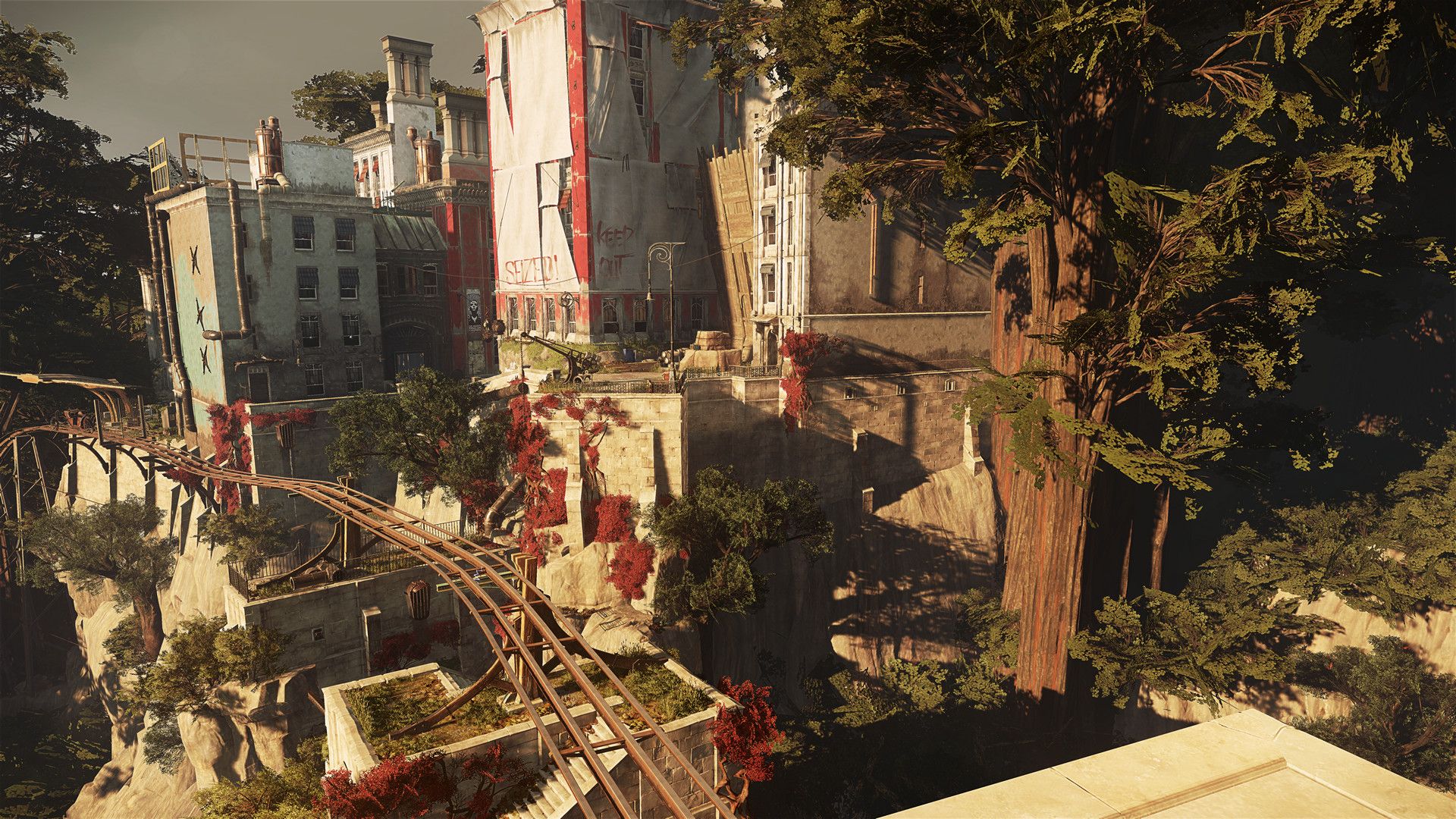
The Clockwork Mansion develops this spatial design into the campaign's clearest achievement. Its rooms physically rearrange, yet the important opportunity is getting behind them. A moving wall becomes something whose function can be understood and used. The machinery gives the player another route through a building that initially seems designed to control every movement.
A Crack in the Slab changes the problem again. Two time states of a mansion offer different access, obstacles and information. The player has to compare versions of a place instead of relying on the usual collection of powers. It is a memorable restriction because it asks for a different kind of attention, rather than simply making enemies tougher.
Neither level stays unfamiliar forever. Returning can reveal a route or support a different approach, but it will not recreate the first discovery of the central mechanism. Their quality does not depend on unlimited novelty. The broader campaign supplies other variations, including the Dust District's faction conflict and alternatives to taking a side. The appeal lies in several distinct authored problems, each with room for experimentation.
Detection leaves room to recover
Dishonored 2's most useful improvement to stealth is the ability to remain nonlethal after a plan goes wrong. A drop can end in a knockout, and a parry can create an opening to incapacitate an opponent. Movement, distractions and supernatural abilities provide ways to retreat or regain control. Being seen need not immediately mean killing everyone or reloading.
That changes the emotional cost of an imperfect approach. A guard turning at the wrong moment can begin an interesting encounter instead of invalidating the player's chosen style. The game is more accommodating of a messy escape than a strict ghost objective suggests. Players who reload after every detection can miss a substantial part of what the tools make possible.
Emily's Domino is a particularly clear example of their flexibility. Linking targets lets an effect applied to one reach the others, making a single incapacitation useful against a group. Doppelganger can redirect attention, while Far Reach offers movement and upgraded interactions with distant objects or people. Combining these abilities is more rewarding than treating each as a separate attack button.
Corvo's abilities provide another set of possibilities through Blink, possession and manipulation of time. The choice of protagonist therefore matters mechanically, but it should be understood accurately: both play through substantially the same missions. A second character changes methods and perspective more than locations or objectives. Choose the powers that invite a different plan, rather than expecting another campaign of entirely new content.
There is also a no-powers route. Supporting it helps explain why the environments contain practical alternatives to supernatural shortcuts. That is a strength for players who want to understand the architecture, and a limitation for those who want a particular ability to be indispensable. The game frequently allows an elegant solution without forcing the player to discover it.
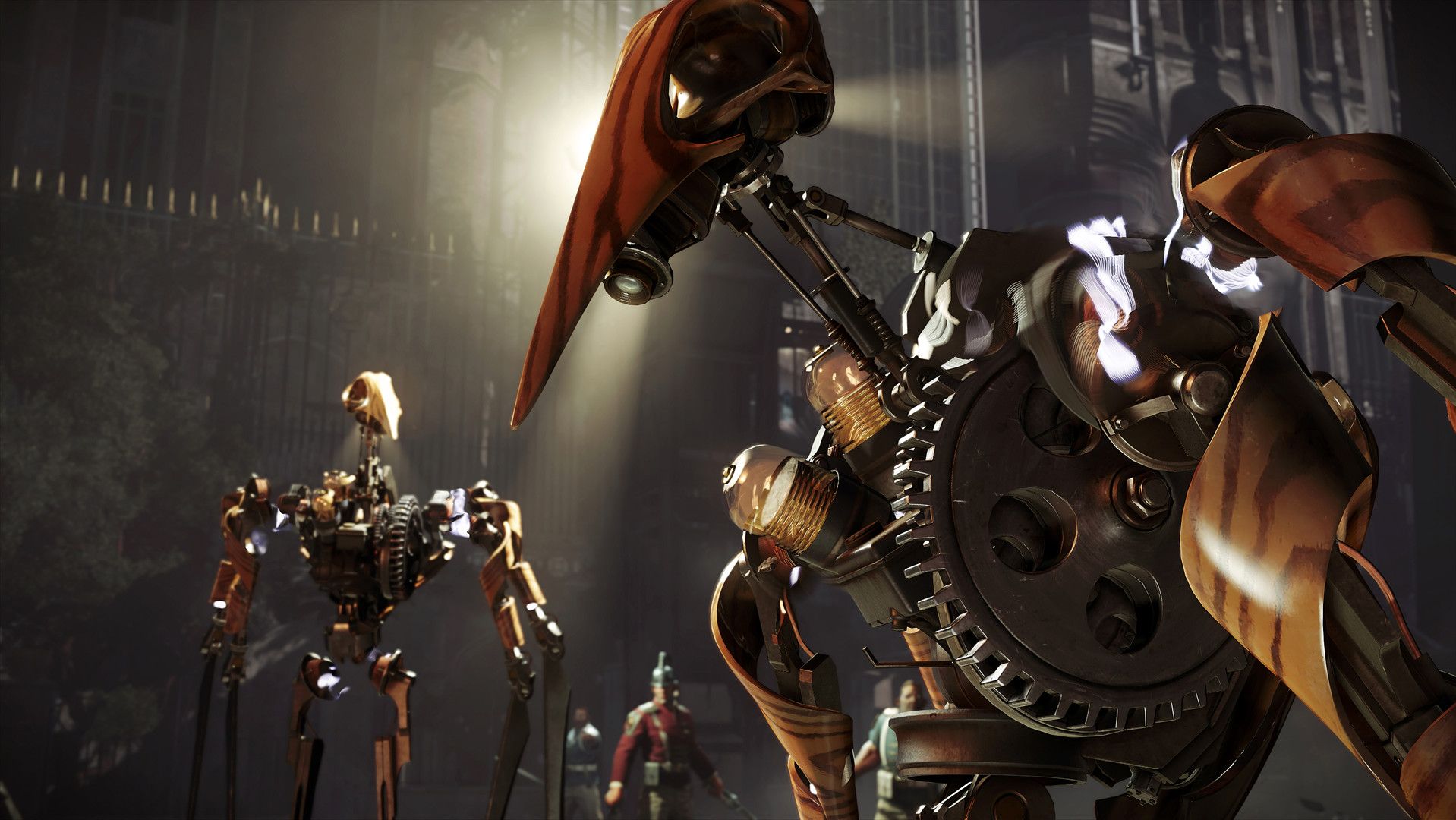
Straight melee is less accomplished than the encounters built around it. Blocking, parrying and following with an attack can become routine, while guards do not always behave consistently enough to sustain believable pressure. Their awareness of a missing colleague can be impressive; their response to a more obvious danger can be much less convincing. Individual opponents are not the main reason to buy the game.
Aggressive play still has considerable appeal when movement, environmental opportunities and powers are involved. The important distinction is between enjoying combinations across a room and expecting deep sword combat on its own. Dishonored 2 is very good at the former. Personal restrictions and difficulty settings can make those combinations more demanding, but supplying that challenge yourself will not suit everyone.
Progression can turn curiosity into obligation
Runes unlock and improve supernatural abilities, coins pay for equipment, and bonecharms modify the way a character operates. Those systems give optional exploration a concrete purpose. Finding a resource can bring a useful power closer, which in turn suggests another way through the next defended area.
Bonecharm crafting adds more control over the modifiers, with corruption creating a risk in more ambitious combinations. It gives found charms a role beyond filling equipment slots. The underlying availability still contains randomness, however. A player planning around one particular effect can wait a long time for the right find, making a rigid build less reliable than an approach that adapts to available tools.
The greater pacing problem comes from trying to collect everything. A route is an interesting choice partly because taking it means leaving another route unused. Returning to search every alternative for its remaining coins can erase that distinction. Instead of committing to an approach, a completionist can end up clearing the whole district after its tactical problem is already solved.
The rewards are not inherently pointless. They support new actions and can justify investigating a room that would otherwise be passed over. The friction appears when the total becomes the objective. Players who habitually empty every map should expect the campaign to feel slower and more repetitive than someone following a particular target and accepting what remains behind.
The best reason for a detour is a question or an upgrade worth pursuing. That preserves exploration as part of a chosen method. The game provides enough useful tools that an imperfect collection does not make a run worthless, and a complete mission does not require a complete accounting of its valuables.
The setting carries more weight than the coup
The opening overthrow provides a clear goal, but it moves too quickly to establish much warmth or complexity in the relationship between Emily and Corvo. Their separation matters to the plot before the game has given it much room to matter emotionally. The campaign then spends long stretches away from Delilah, leaving its central antagonist less present than the task of defeating her needs.
Emily is the more natural fit for the story. A ruler forced to confront life outside her court has an immediate connection to the conditions visible in Karnaca. Corvo remains a strong mechanical option, but his return does not make every part of that political lesson equally convincing. The shared campaign sometimes accommodates its second protagonist more successfully in level design than in dialogue.
Spoken observations can also reduce the subtlety of an already readable scene. Notes, rooms and overheard conversations often communicate more effectively because they let the player connect details. The contrast between the setting's specificity and the main plot's simpler revenge structure is one of the game's clearest weaknesses.
That does not make the story entirely without interest. The consequences of violence give methods significance, and a nonlethal target outcome is not automatically a merciful one. Some alternatives are deliberately cruel. Those choices complicate an easy equation between low body count and good conduct, even when the broader narrative does not examine every implication as thoroughly as it could.
There is enough motive to support the missions, and the surrounding world rewards a reader willing to investigate it. There is less reason to recommend the game chiefly for its central cast or dramatic payoff. Players who came for a gripping revenge story should adjust that expectation before buying.
The current package favors deliberate replays
Several useful features arrived after launch. New Game Plus permits combinations drawn from both protagonists' powers. Mission selection and custom difficulty make it easier to revisit a particular location and adjust individual pressures. Mission selection carries the campaign state from the start of that mission, so it is not an unrestricted character editor.
Custom difficulty includes controls for details such as detection while leaning and the number of enemies attacking at once. That is more useful than treating challenge as one indivisible setting. It gives players ways to alter specific frustrations or impose a narrower test. These are meaningful options, although a settings list alone cannot establish that the game meets every accessibility need.
PC performance requires a separate judgment. The launch problems were substantial, and subsequent official updates addressed technical faults. Those historical results should not be presented as current benchmarks. Later experiences include both satisfactory play and continuing compatibility complaints, without enough consistent hardware and build detail to promise a result for every system. No new performance measurement supports such a promise here.
The practical advice is to check operation on the computer you intend to use, including performance outside the opening interiors. A game being older does not guarantee that every current setup will handle it without trouble. Equally, a poor result from a 2016 build does not establish that the present purchase is unusable.
The US Steam listing checked on September 20, 2026, prices the base game at $29.99. Death of the Outsider is a separate game, and collection offers should be compared on their actual contents. Dishonored 2 is worth that base price for a player who wants to study its locations and return with another method. For someone interested mainly in the plot or one straightforward fighting run, wait for a sale. Its strongest value is the freedom to understand and use a place well.