
Dune: Awakening Review: Great Survival, Weak Endgame
Arrakis supports an excellent survival climb, but blunt combat, repetitive quests and a divisive endgame stop it from reaching the top tier.
Dune: Awakening gets the hard part right. Arrakis is dangerous before another player enters the picture. Heat, exposure, scarce water and sandworms shape every trip, while better tools gradually turn survival into control. The first half is one of the strongest survival-game progressions available. The problem is what happens after that climb: combat remains blunt, quests repeat, and the endgame asks players to tolerate systems that are less interesting than the desert that supports them.
This is a research-based Game Pelt review. It draws from five established video-review channels, five written reviews, technical testing, official documentation and current patch information. Game Pelt is not claiming a private playthrough or performance capture. The verdict weighs the points that remain consistent across those independent sources and notes where reviewers disagree.
The survival loop understands Arrakis
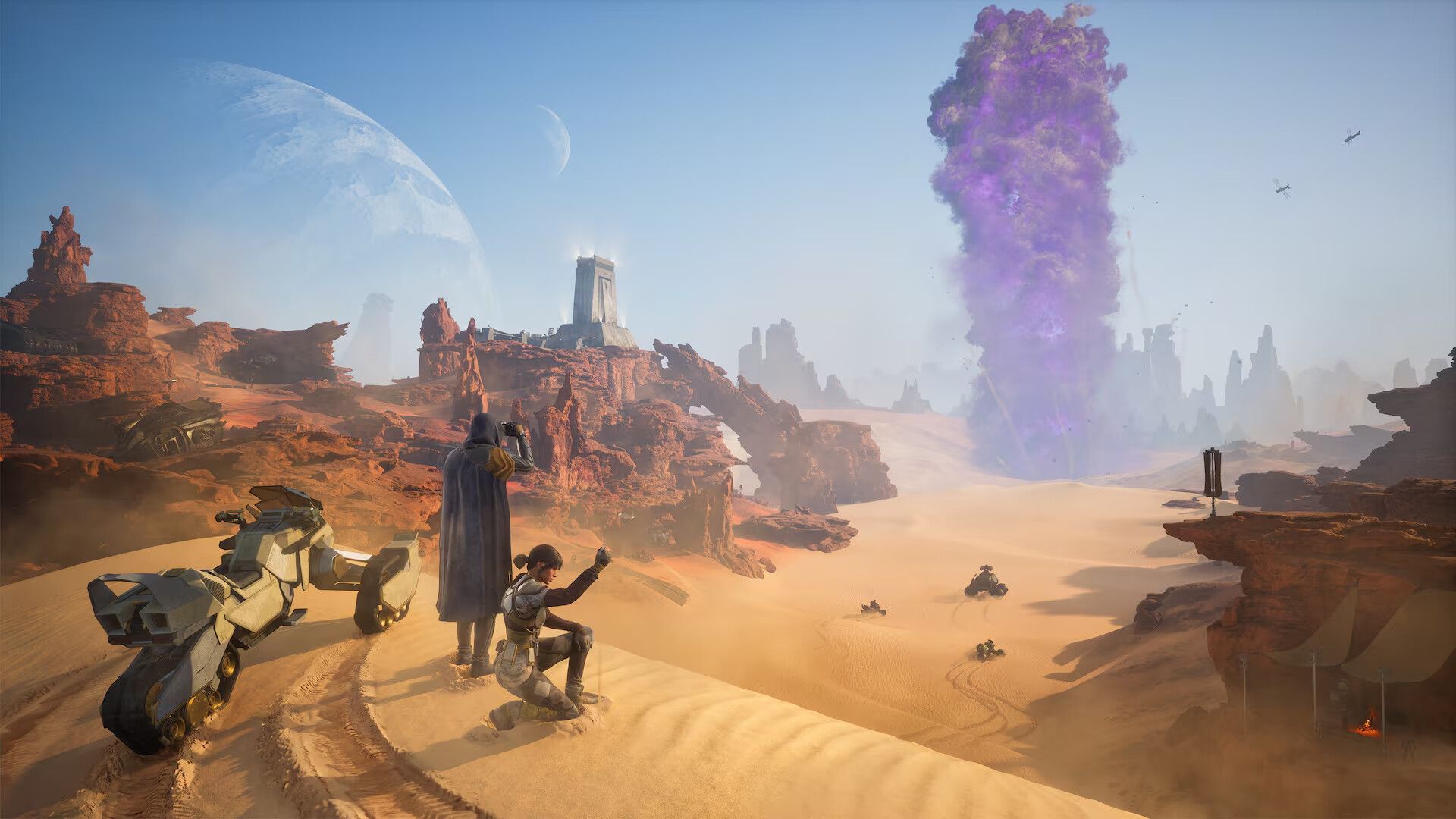
Early progression is the clearest success. Leaving shelter without a route or enough water is dangerous, and crossing open sand creates a direct threat from worms. That makes basic decisions matter. A rocky path may be slower but safer. A distant resource can be valuable and still not justify the trip. Shade is not decoration; it is part of route planning.
Several reviewers describe the opening as a convincing rise from vulnerability to competence. That reading holds because the technology changes what a player can do instead of only making numbers larger. A stillsuit extends a journey. A sandbike reduces travel time but creates new storage and recovery concerns. An ornithopter finally lets the player read the basin from above. Each major tool changes the relationship with the map.
Base building supports that progression. Construction is flexible enough to make a useful home without demanding architectural obsession, and the blueprint system helps preserve work when a move becomes necessary. The result is a survival game where a base functions as logistics: storage, water processing, crafting and launch point. It is still possible to spend hours decorating, but the system does not require that investment before it becomes practical.
Arrakis is more than a licensed backdrop
The adaptation works because Dune's rules affect play. The desert punishes careless movement. Personal shields solve one problem while creating others. Political factions matter to progression. Spice is not just a valuable crafting icon; it sits inside the economy and the fiction. IGN, Eurogamer, PC Gamer and Meristation all put the world near the center of their praise, even when they disagreed about the endgame.
Funcom uses an alternate timeline, which gives the game space to involve familiar houses and institutions without forcing every player into Paul Atreides' story. The main narrative is uneven, but the setting carries it. Locations, equipment and terminology are integrated well enough that existing fans can recognize the world while new players still receive functional reasons to care about its systems.
The audiovisual work reinforces the scale. Empty terrain is difficult to make readable, yet ridges, rock formations, storms and distant structures create useful landmarks. Sound communicates approaching danger without constantly filling the desert. The game understands that silence and distance are part of Dune's appeal.
Combat never matches the survival systems

Combat is the most consistent weakness across the research. Guns, blades, shields and class abilities create a broad toolset, but the moment-to-moment feedback is weak. Enemies often pressure through durability or numbers rather than intelligent positioning. Melee attacks lack weight, ranged encounters settle into familiar peeking patterns, and human AI does not make enough use of the spaces around it.
The problem becomes more visible because combat appears so often. Camps and contracts reuse similar enemy groups and objectives. A serviceable system can support occasional danger; it is harder to ignore when routine progression asks the player to clear another compound for another material or schematic.
There are good tactical ideas. Shields change weapon choices, abilities can control space, and preparation matters. Group play also covers some of the weakness because roles and coordination create decisions the enemies do not. None of that produces combat as strong as the travel, crafting or base systems. Players coming primarily for a shooter or action RPG should adjust expectations.
The middle of the game is the best part
Once basic survival stops consuming every minute, Dune: Awakening opens. The player has enough equipment to travel with intent but has not yet exhausted the meaningful upgrades. This is where exploration, contracts, base projects and faction progression reinforce one another. A trip can reveal a resource route, provide a schematic and create a reason to rebuild the vehicle bay.
The Hagga Basin also supports solo play better than the MMO label suggests. Other players exist in the world, but much of the core progression can be approached independently. Cooperation improves efficiency and makes dangerous expeditions easier. It is not required for every useful activity.
That flexibility is why the first dozens of hours earned stronger responses than the late game. GameSpot found the mixture difficult to put down before repetition took over. Force Gaming reached a similar split after a much longer time investment: excellent progression and traversal, followed by a Deep Desert structure that did not sustain the same quality. Those conclusions come from different review methods, but they identify the same break.
Quest design spends too much time on errands
The main story occasionally changes the pace with traversal, visions and more directed sequences. Too many supporting quests still rely on travel, collection and camp clearing. The writing has useful lore and faction context, but the objective design regularly turns that material into routine work.
This matters because travel is already a resource calculation. A long trip can be satisfying when the destination changes the player's understanding of the world. It feels padded when the reward is another small step in a chain of errands. The strongest survival games make logistics part of the challenge without using distance to disguise thin objectives. Dune: Awakening does both, depending on the mission.
The Deep Desert is still the wrong finish line for many players
The endgame shifts attention toward the Deep Desert, high-tier resources, Landsraad objectives and conflict between groups. On paper, the weekly changing map and political competition give long-term players a reason to organize. Eurogamer viewed the transition from survival game to RPG to guild-based MMO as a strength. Other reviewers, including GameSpot and Force Gaming, found the later structure less focused and more dependent on PvP or scheduled group activity.
The disagreement is useful because it identifies the audience. Players who want guild logistics, contested resources and a reason to return on a schedule may see the endgame as the point. Solo players and small groups who enjoyed the measured climb through Hagga Basin can reach the top and find that the game has changed its priorities.
Funcom has already adjusted the balance between PvE and PvP access, and current updates continue to add options. The direction is better than it was at launch, but the core issue is not just the size of a safe zone. The later game needs goals that are as mechanically satisfying as learning to survive, building the first serious base and taking the first ornithopter into the air.
Performance is improved, not invisible
Technical reports describe a demanding game with strong visual results and recurring shader, streaming or traversal stutter depending on hardware and settings. DLSS and other reconstruction options help performance, but they do not erase every hitch. Launch bugs and server issues have been reduced through updates, although a large online survival game remains vulnerable to patch-specific problems.
The important distinction is that Dune: Awakening is not broadly described as broken. Its technical faults interrupt a generally functional game. Buyers on minimum or older recommended hardware should still check current benchmarks for their exact class of GPU and CPU, because broad system requirements do not explain how a busy base or rapid traversal will behave.
Solo mode improves access, not the underlying design
The newer single-player support is valuable for people who wanted Arrakis without social pressure. It reduces one barrier and gives players more control over pace. It does not automatically rewrite repetitive quests, basic enemy behavior or the late-game reward structure. Treat it as a better way to access the existing game, not a replacement campaign built around solo play.
Verdict
Dune: Awakening is good, and parts of it are excellent. The survival progression, traversal, base logistics and treatment of Arrakis justify the game for Dune fans and survival players. Combat and quest repetition keep it below the best games in either field, while the endgame serves organized groups better than the solo players who may enjoy the opening most.
Buy it if the idea of planning desert routes, building a working base and earning new forms of travel sounds better than chasing perfect combat. It is easier to recommend with friends, but the main climb works alone. Wait for a sale if you need strong enemy AI, varied missions or a PvE endgame with a clear finish. Skip it if survival crafting already feels like work; the Dune setting improves the formula, but it does not remove the formula.
Game Pelt verdict: 7.5/10. A convincing survival game on Arrakis, held back by ordinary combat and a late game that cannot match the journey into it.