
Factorio Main Bus Guide: Leave Space For The Factory You Have Not Built
A useful main bus is easy to tap, honest about throughput and temporary enough to hand work over to trains when scale demands it.
A Factorio main bus solves one specific problem: it gives common materials a predictable route through the factory. It does not guarantee enough production, and it does not need to carry every intermediate item. Build it so shortages are visible and new production lines can connect without demolishing half the base.
Decide where the bus is allowed to grow
Run the bus away from smelting through open ground. Keep production on one side at first. That leaves the other side available for extra belt groups, rail crossings or a second row of factories once the real shape of the base becomes clear.
Groups of four belts remain easy to cross with underground belts, but the exact number matters less than consistent gaps. Leave at least two tiles between groups. More space is reasonable when pipes, later belt tiers or frequent crossings are expected.
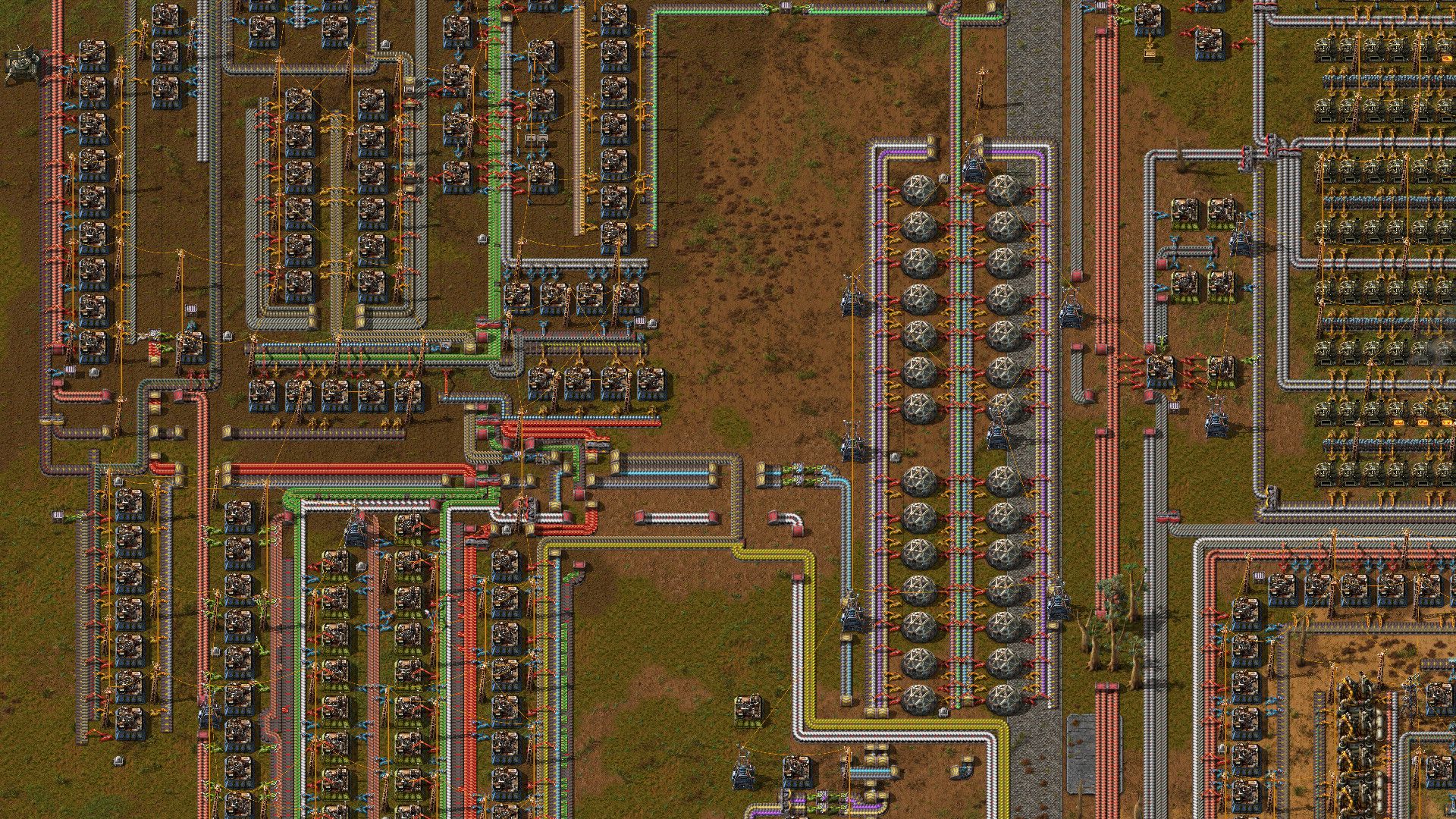
Carry materials that several factories need
Iron plate and copper plate belong on almost every early bus. Steel, green circuits, red circuits, plastic, stone brick and selected fluids become sensible additions as demand appears. The bus should carry shared inputs, not every product the factory can make.
Copper cable is the standard warning. It takes more belt space than the copper plate used to make it, so produce cable beside the machines that consume it. Gears can also be made locally when only one nearby line needs them. Add an item to the bus because multiple areas require it, not because a blueprint included a lane.
Nilaus's main-bus workshop treats the bus as a set of components: production entering from the start, parallel transport lanes, controlled split-offs and room for later capacity. Trupen's beginner explanation reaches the same practical point from a smaller design: readability is the benefit. KatherineOfSky's injection-bus episodes show the next step, where new production is deliberately fed into lanes instead of pretending the original smelters can supply the entire factory forever.
A full belt is not proof of enough production
A backed-up lane can look healthy while machines farther down the bus are waiting. Check flow while science and major production blocks are running. If a lane empties before the final consumers, improve the source or inject more material downstream. Adding another empty belt beside a weak source only creates a wider shortage.
Priority splitters can keep one lane or branch supplied, but they redistribute existing throughput. They do not create items. Use priorities when a critical line must run first, then fix production if the rest of the factory is starved.
Take clean branches instead of peeling items everywhere
Split a belt toward each production block and keep the branch perpendicular to the bus where possible. This makes the destination obvious and leaves a repeatable place for underground crossings. Directly removing items from several lanes works, but an inconsistent pattern becomes difficult to audit when something stops.
Balance only when the distribution problem is real. Factorio players often spend more time building large balancers than the factory needs. A splitter, lane swap or targeted injection is usually enough for a starter bus.
Build in modules that can extend away from the bus
Place assemblers so a production line can grow outward. If the bus runs east, let the factory block expand north or south instead of building its next stage into the path of the bus. Leave room for output belts, inserters, power and a return line when the product will join the bus.
Avoid surrounding a new science block with unrelated permanent structures. Early estimates are usually wrong. Space is cheaper than rebuilding while several dependent lines are running.
Know when the bus has finished its job
The official Factorio Wiki describes a bus as particularly useful from early through mid-game and notes that robots or rail systems can replace parts of it later. That is not a failure. A bus is valuable because it gets a factory organized before demand and geography are fully understood.
Move high-volume or remote production to trains when the bus becomes a long sequence of emergency injections. Use logistic robots for low-volume, high-variety deliveries where their energy and charging limits make sense. Keep the bus for stable shared materials until replacing it removes more complexity than it adds.
The useful rule is simple: every lane needs a known source, every branch needs a readable destination, and every production block needs somewhere to expand. A bus that meets those conditions can be modest and still carry a factory through the difficult middle of the game.